
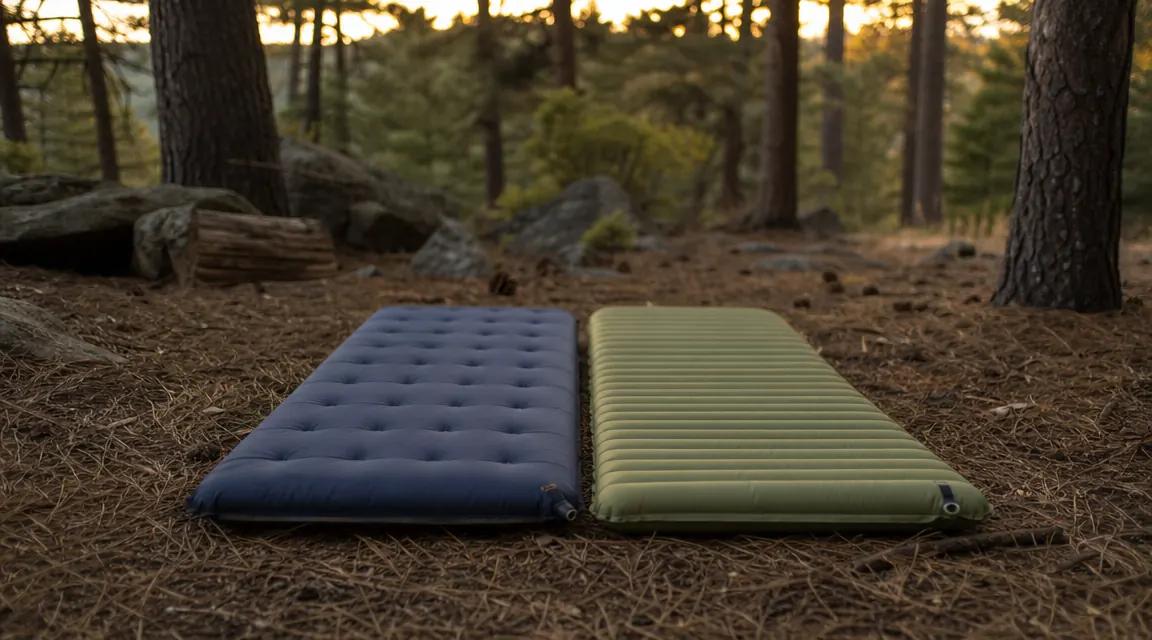
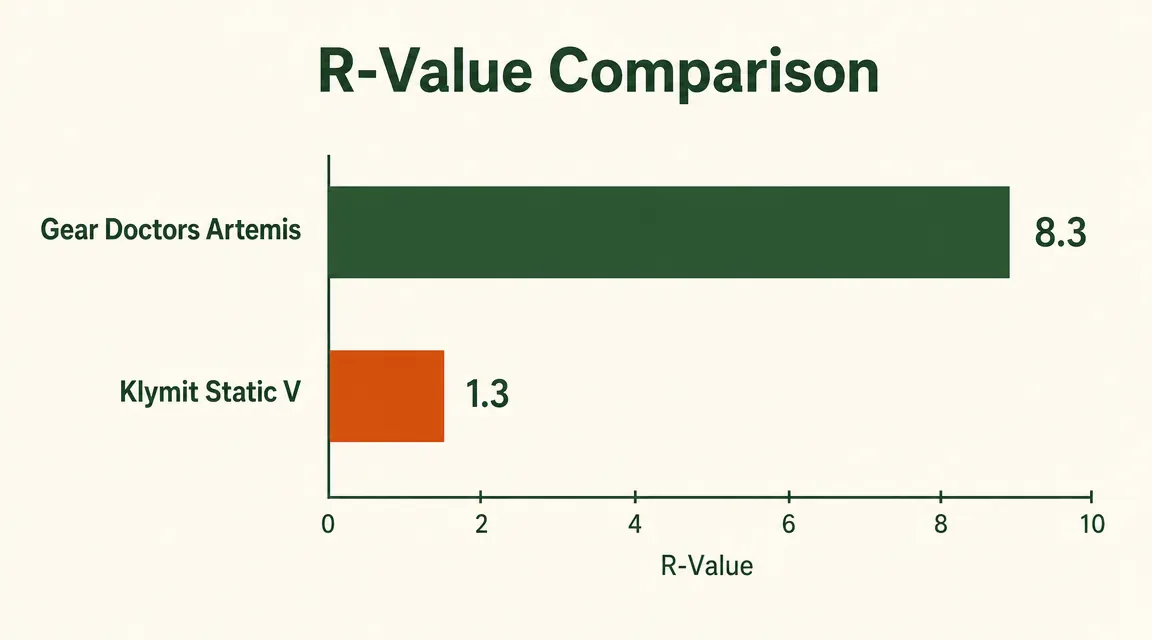
The short answer: if you camp in any weather below 50 degrees Fahrenheit, the Gear Doctors Artemis is the clear choice and it is not close. Its 8.3 R-value puts it in a completely different thermal category than the Klymit Static V, which sits around R-1.3 depending on the version. If you camp only in July and August, in mild lowland conditions, the Klymit will do the job and save you some money. For almost everyone else, the Artemis earns its price.
I spent 22 years as a park ranger in the Pacific Northwest before I retired, and I have slept on every surface imaginable: rock slabs, root-tangled tent pads, sandy river bars, frozen ground at 9,000 feet. A sleeping pad is not optional equipment. It is a thermal barrier between your body and the ground, which pulls heat away from you far faster than cold air does. I have seen campers with a 20-degree bag shiver through the night on a thin pad because nobody told them the pad matters as much as the bag. So when I test two pads this far apart in R-value, I take the comparison seriously.
| Spec | Gear Doctors Artemis | Klymit Static V |
|---|---|---|
| R-Value | 8.3 | 1.3 (non-insulated) / 4.4 (insulated) |
| Inflation Type | Self-inflating with top-off valve | Manual inflate / Klymit pump |
| Thickness | 3.75 inches | 2.5 inches |
| Weight | 4.2 lbs | 1.65 lbs (standard) |
| Packed Size | Rolls to 11 x 6 inches | Rolls to 8.5 x 5 inches |
| Included Pillow | Yes (integrated) | No |
| Repair Kit Included | Yes | Sold separately |
| Best Use | 3-season car camping, shoulder season backpacking | Summer backpacking, weight-critical trips |
| Current Price | ~$105 | ~$55-90 depending on version |
Where the Gear Doctors Artemis Wins
The Artemis wins on warmth by a margin that matters in real conditions. An R-value of 8.3 means this pad is rated for serious cold-weather use. For context, most sleeping pad manufacturers suggest R-2 for summer use, R-3 to R-4 for three-season, and R-5-plus for winter. The Artemis at 8.3 is firmly in the winter/extreme category, which means it handles shoulder-season and cool-summer nights with ease. A standard Klymit Static V at R-1.3 is a summer-only pad, full stop. If you buy the standard Klymit for a September trip in the mountains, you will be cold.
The self-inflating mechanism on the Artemis is also a meaningful convenience advantage. You unroll it, open the valve, and it does most of the work on its own using the open-cell foam inside. After two to three minutes you add a few breaths to firm it up to your preference and you are done. The Klymit Static V requires you to inflate it entirely by mouth or with a separate pump. After a long hiking day, kneeling over a pad and blowing it up for three minutes is a small but real annoyance. The Artemis removes that friction completely. The integrated pillow also pulls real weight here. The Artemis comes with a pillow built into the head end of the pad. The Klymit does not include a pillow. If you pack a separate pillow, you are adding weight and taking up space that cancels out some of the Klymit's size advantage.
The Artemis also ships with a patch repair kit included in the box. This matters more than it sounds. Any inflatable pad is vulnerable to puncture, and a slow leak discovered at 11 p.m. is miserable without a patch. Gear Doctors builds the repair kit into the purchase. Klymit sells a repair kit separately. For a car camper, the weight of carrying a small patch kit is zero. Not having one when you need it is not zero.
You will sleep warmer tonight than you did on your last trip.
The Gear Doctors Artemis 8.3 R-Value Self-Inflating Sleeping Pad has 4,783 ratings at 4.5 stars. It includes an integrated pillow and a repair kit. If you camp in anything other than peak summer, this is the pad to buy.
Amazon Check Today's Price on Amazon →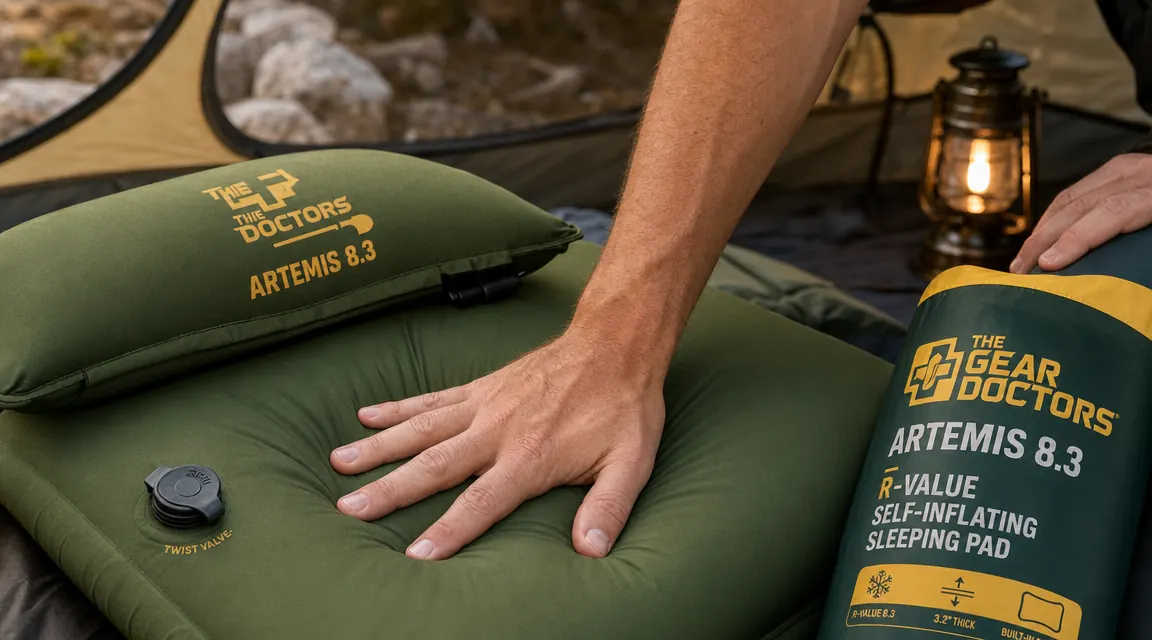
Where the Klymit Static V Wins
The Klymit wins on weight and packed size, and for backpackers those two numbers dominate every other consideration. The standard Klymit Static V weighs 26 ounces. The Artemis weighs 4.2 pounds, which is 67 ounces. That is 41 extra ounces, about 2.5 lbs, that you are carrying on your back over miles of trail. For a car camper who carries their gear from the car to a campsite 50 feet away, that weight difference is irrelevant. For someone doing a 10-mile day on a backpacking trip, that weight difference is significant and will affect every step.
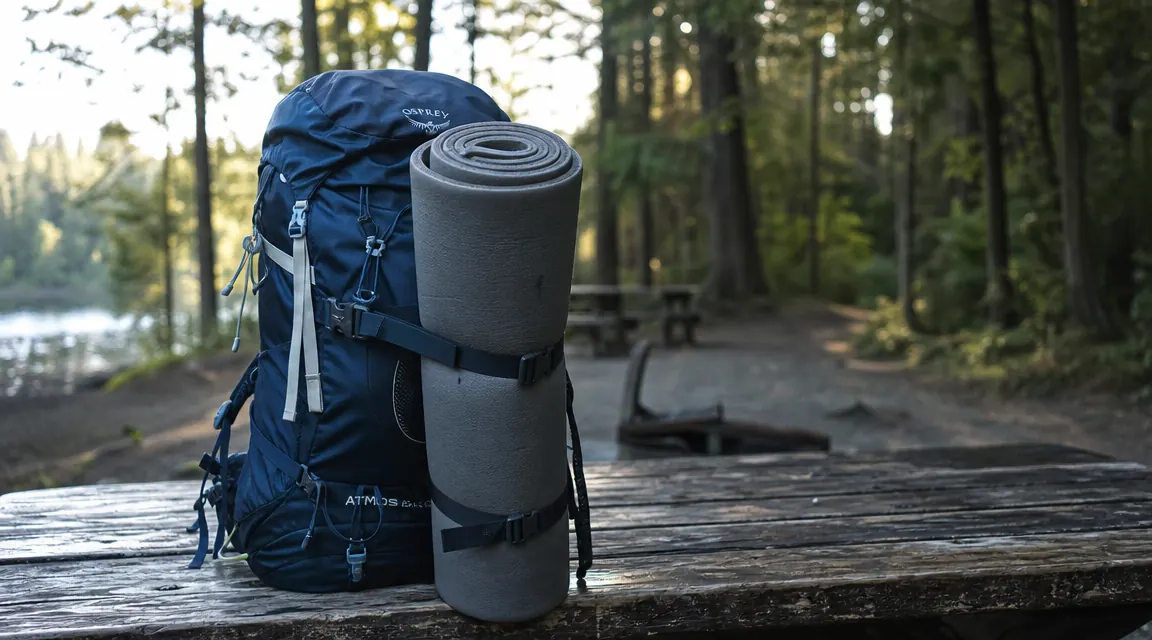
The Klymit is also the right choice when budget is the driving factor and conditions allow it. If you camp exclusively in summer, in climates that stay above 55 degrees at night, the R-value difference between these two pads will not matter in practice. You will be comfortable on the Klymit and you will spend less money. The Klymit also rolls smaller, which means it fits inside a pack more easily than the Artemis, which typically rides strapped to the outside of a bag. For ultralight and minimalist packers, the size difference matters as much as the weight.
Your sleeping bag rating is only as accurate as the pad you are sleeping on. A 15-degree bag on an R-1.3 pad is not a 15-degree sleep system. The ground steals heat faster than the air does.
The R-Value Gap Is Not a Detail
I want to spend a moment on this because it is the most important thing about this comparison and a lot of shoppers gloss over it. R-value measures thermal resistance. It is not a comfort rating or a cushion rating. A pad with R-1.3 will let cold ground steal your body heat much more quickly than a pad with R-8.3. When you are sleeping, you lose roughly 30 percent of your body heat through conduction downward into the ground. Your sleeping bag insulates you from the cold air above and around you, but it compresses under your body weight and provides almost no insulation on the side in contact with the pad. This is why a high-R pad and a warm bag together create a warm sleep system, but a warm bag on a thin pad leaves you vulnerable.
The practical result: if you are camping in the shoulder season, even on nights that feel mild when you go to bed, a thin pad will wake you up cold at 3 a.m. when ground temperatures drop and the pad can no longer buffer the cold pull. I have seen this happen to experienced campers who bought the right sleeping bag and skimped on the pad. The Artemis's 8.3 R-value eliminates this problem for three-season camping entirely. You will not wake up cold from ground conduction. The Klymit at R-1.3 does not offer that same protection.

Comfort Side by Side
The Artemis is 3.75 inches thick when fully inflated. The Klymit Static V is 2.5 inches. Both are side-sleeper capable, but the Artemis gives more buffer between your hip and the ground on hard surfaces. Car camping often means tent pads that are not perfectly flat, or ground that has roots or rocks hidden under the surface. The extra inch-and-a-quarter on the Artemis is meaningful padding on uneven terrain. The Klymit's V-chamber construction does a good job distributing pressure across its baffles, and it is comfortable for back and stomach sleepers on relatively flat ground. Side sleepers on hard surfaces will notice the difference.
The Artemis's open-cell foam core also gives it a more mattress-like feel that some campers prefer over the slightly floating sensation of a fully air-filled pad. When you shift in the night, the self-inflating foam responds more like a real mattress. The Klymit, being fully air-filled in its chambers, has a slight bounce to it that some people love and others find unsettling. This is genuinely subjective. I prefer the foam feel of the Artemis, but I have camped with people who strongly prefer the Klymit's lighter, air-chamber feel.
Who Should Buy Which
Buy the Gear Doctors Artemis if you car camp, base camp, or do any camping in temperatures below 60 degrees Fahrenheit. It will keep you warm when the ground is cold, it inflates itself, it comes with a pillow and a repair kit, and its 4,783 ratings at 4.5 stars show it holds up over many trips. The weight is a non-issue for car campers and a minor issue for weekend backpackers doing short mileage. If you want one pad that works reliably across spring, summer, fall, and mild winter conditions, this is it.
Buy the Klymit Static V if you are an ultralight or minimalist backpacker counting every ounce on long mileage days, and you camp only in warm-weather summer conditions where nights stay above 55 degrees. At under 2 pounds, it is genuinely light, and the smaller pack size is a real advantage for fitting into a loaded pack. If you later find yourself wanting to camp into shoulder season, plan to add the Klymit Insulated version, which bumps the R-value up to 4.4 and brings you into three-season territory, though at higher cost than the standard.
The honest version of this comparison: for most campers reading this page, the Artemis is the better buy. Most people who buy camping gear are not ultralight backpackers who track ounces on a spreadsheet. Most people are loading a car, driving to a campsite, and setting up a tent on ground that gets cold at night. The Artemis is built for exactly that camper and it does that job very well.
Final Verdict
The Gear Doctors Artemis wins this comparison for the majority of campers. Its 8.3 R-value is the most important specification on any sleeping pad for three-season use. Combined with its self-inflating convenience, its included pillow, its 3.75-inch cushion thickness, and a repair kit that is already in the box, it is a complete, ready-to-use sleep system at a reasonable price point for what it delivers. The Klymit Static V is a good pad for a narrow use case: warm-weather, high-mileage backpacking where weight is the primary constraint. For car campers, families, couples, and anyone camping outside of July and August, the Artemis is the correct choice.
Stop waking up cold at 3 a.m. because your pad cannot keep up.
The Gear Doctors Artemis 8.3 R-Value Self-Inflating Sleeping Pad is in stock on Amazon with free Prime shipping. Pillow and repair kit included. Over 4,700 verified reviews at 4.5 stars.
Amazon Check Today's Price on Amazon →