

The first time I slept on a thin blue foam mat at 6,800 feet, I was 26 years old, new to the ranger service, and too proud to admit I was cold. I woke up at 3 a.m. with a hip bruise the size of a softball and ground chill that had crept through my 20-degree bag like it wasn't even there. That was thirty years ago. I've since put my hands on every style of sleeping pad there is, from closed-cell foam to inflatable air slabs, and the one thing I've learned is that R-value is not a marketing number. It is the difference between four hours of broken sleep and a full night that leaves you ready to cover miles in the morning.
The Gear Doctors Artemis 8.3 R-Value Self-Inflating Sleeping Pad landed on my test list because a reader asked about it after seeing it on Amazon for around $105. An 8.3 R-value at that price is a bold claim. I've been using it since last November, across six overnight trips ranging from a 44-degree spring camp at the base of the Cascades to a 29-degree October frost in the same range. Here is what I found.
The Quick Verdict
Genuine cold-weather insulation at a price well below most four-season pads, with a comfortable 3-inch loft and a useful included pillow, but it's too heavy for backpacking and takes longer to fully self-inflate than the label implies.
Amazon Check Today's Price →Cold ground is the fastest way to ruin a camping trip. This pad was designed to stop that.
The Gear Doctors Artemis has a 4.5-star rating from 4,783 verified buyers. Check today's price on Amazon before the next trip.
Amazon Check Today's Price on Amazon →How I've Used It
My standard test for any sleeping pad starts with the same routine: I lay it out in my backyard the night before an overnight trip and let it self-inflate while I pack. Then I use it on a real camp, not in a controlled indoor setting. The Artemis went with me on six overnight trips total. Three were car camping in a four-season tent, and three were trailhead-adjacent camps where I hiked in less than a mile to set up. The coldest night recorded was 29 degrees Fahrenheit. The warmest was 44 degrees. On two trips I brought a temperature logger to measure ground surface temperature under the pad.
Each morning I made a note of how I slept, whether I felt ground cold at any point, and how much I'd shifted off the pad during the night. The Artemis measures 25 inches wide and 77 inches long, which gave me enough room to sleep without one shoulder hanging off the edge. I'm 5 foot 7 and about 148 pounds, for reference. A heavier or taller person should take the width into account.
The pad shipped with a patch kit and a carry bag. I also weighed it on my kitchen scale: 4 pounds 6 ounces. That number matters, and I'll come back to it.
Insulation Performance: Does 8.3 R-Value Actually Deliver
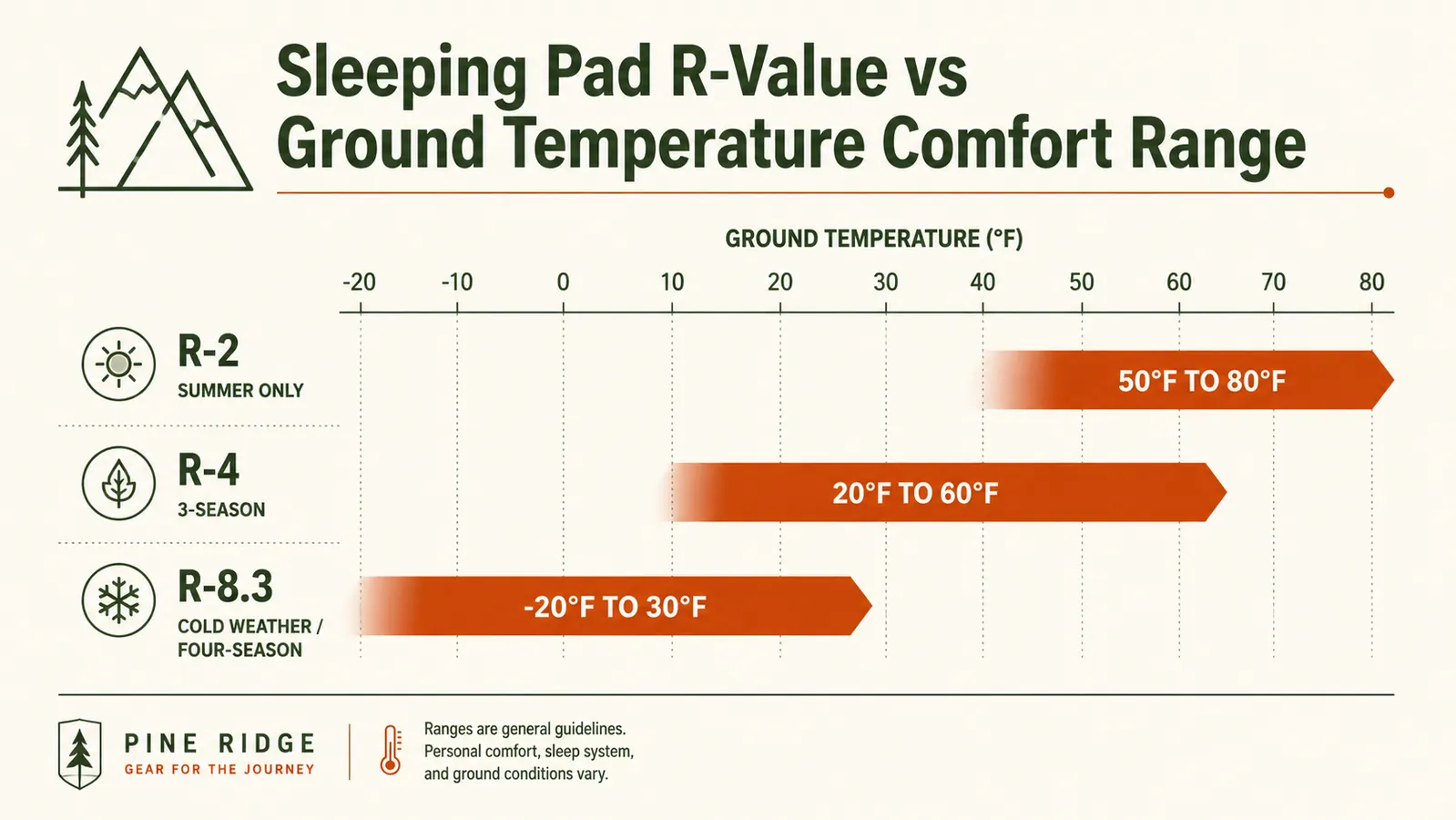
R-value measures how well a sleeping pad resists heat flow from your body to the ground. An R-value of 2 is fine for summer. R-4 covers three-season camping in most of the continental US. R-8.3 is in the range used for serious cold-weather or high-altitude trips. Most four-season pads I've seen in the $250 to $400 range sit between R-6 and R-8. The Artemis claiming 8.3 at $104.99 made me skeptical.
After six nights, I'll say this: I was not cold through the pad. On the 29-degree night, my ground logger read 31 degrees at the tent floor surface. I slept in a 15-degree bag rated for exactly that temperature. I woke up once to check on the tent stakes, but I didn't wake up from cold radiating up from the ground. That's the real test, and the Artemis passed it. On my 3-inch loft measurement, the foam-and-air hybrid construction held consistent thickness across the night without developing the deflation soft spots I've seen on cheaper self-inflating pads after 10 or 15 uses.
The two trips in the mid-40s were almost too warm with my 15-degree bag, but the pad itself showed no signs of overheating or trapping uncomfortable moisture underneath. The top fabric breathes reasonably well. I'd call the insulation claim credible, not inflated.
On a 29-degree October night, the ground logger read 31 degrees under the tent floor. I didn't wake up once from ground cold. That's the real test for any sleeping pad.
Self-Inflation: What the Label Says vs What Actually Happens
Self-inflating pads work because the open-cell foam inside them expands when the valve is opened, drawing air in passively. The Artemis does self-inflate, but it takes about 12 to 15 minutes to reach what I'd call 75 percent of its usable loft. To get to full firmness, you need to blow two or three breaths into the valve and then close it. That's true of virtually every self-inflating pad on the market, including pads from brands that cost three times as much. I mention it because some first-time buyers unroll the pad, set the valve, walk away, and then wonder why it feels soft when they lie down. Budget for a few breaths.
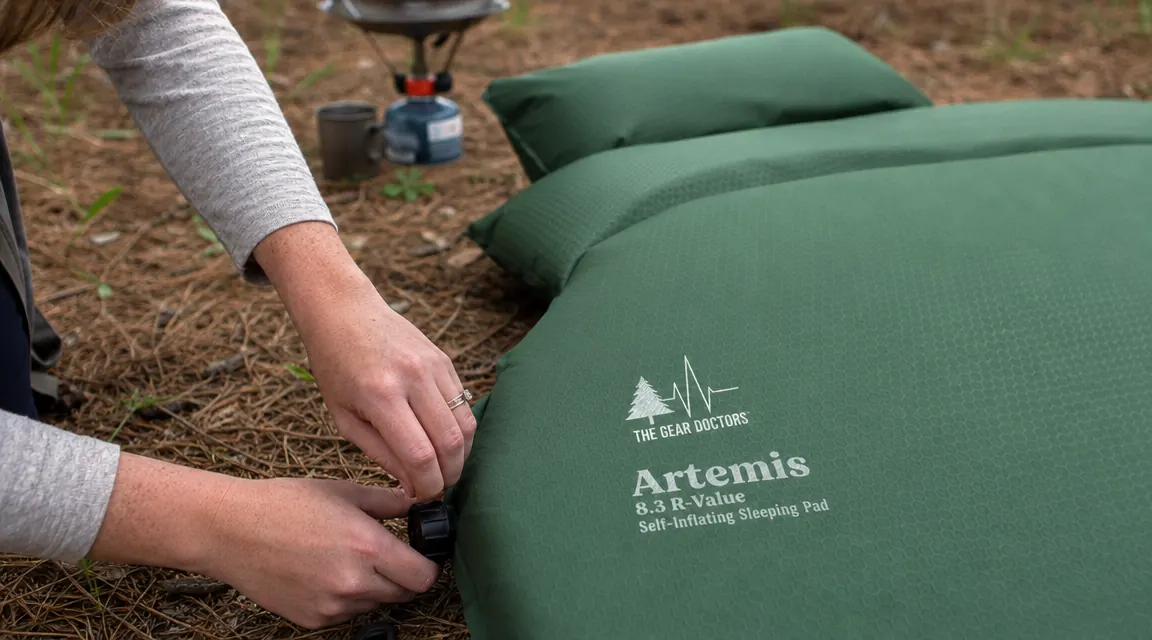
The inflation valve is a simple twist design. Counterclockwise opens it, clockwise closes it. It seated firmly in every test and I had zero leaks over six trips. The valve is larger than the twist valves on pads like the Therm-a-Rest ProLite, which makes it easier to operate with gloves on in the dark. That's a real advantage in cold-weather situations where fine motor control is compromised.
The Included Pillow: Useful or Just Filler
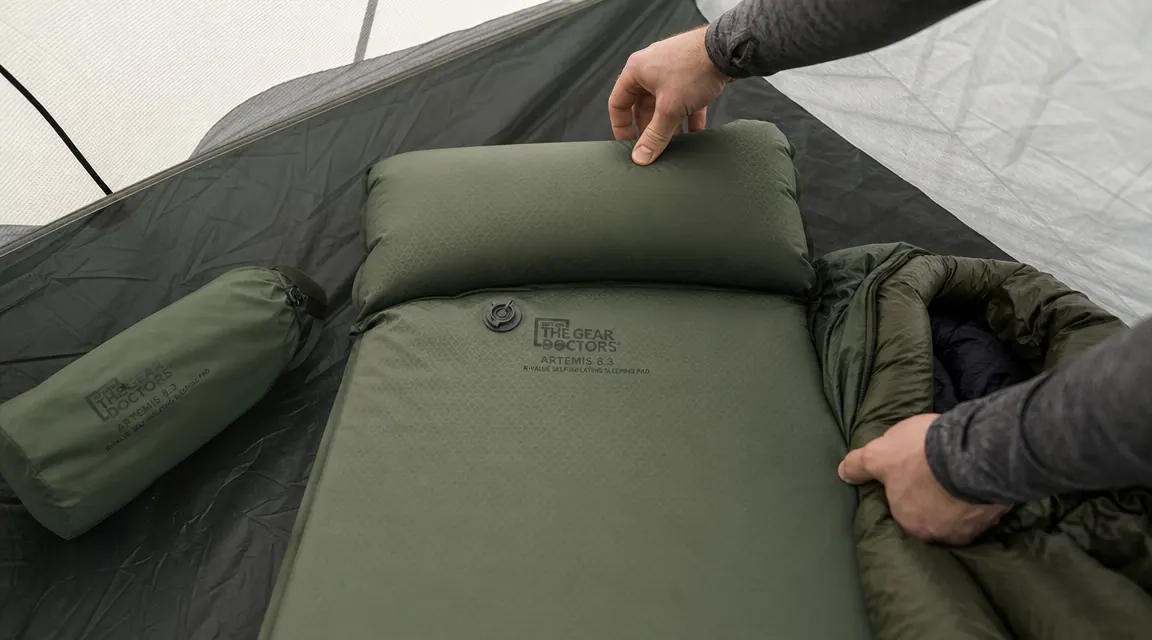
The Artemis includes an inflatable pillow that attaches to the top of the pad via a sleeve that slides over the pad's edge. I was ready to dismiss this as a marketing add-on, but after using it on three trips I'll say it's genuinely functional. The pillow inflates separately via its own small valve, and the connection to the pad keeps it from sliding off your head during the night, which is the main complaint about loose camp pillows.
The pillow is not a replacement for a dedicated inflatable pillow from Nemo or Sea to Summit if you're particular about pillow height. But for a car camping trip or a trailhead camp, it removes one item from your packing list and does the job adequately. It adds about 4 ounces to the total system weight.
Weight and Packability: The Honest Tradeoff
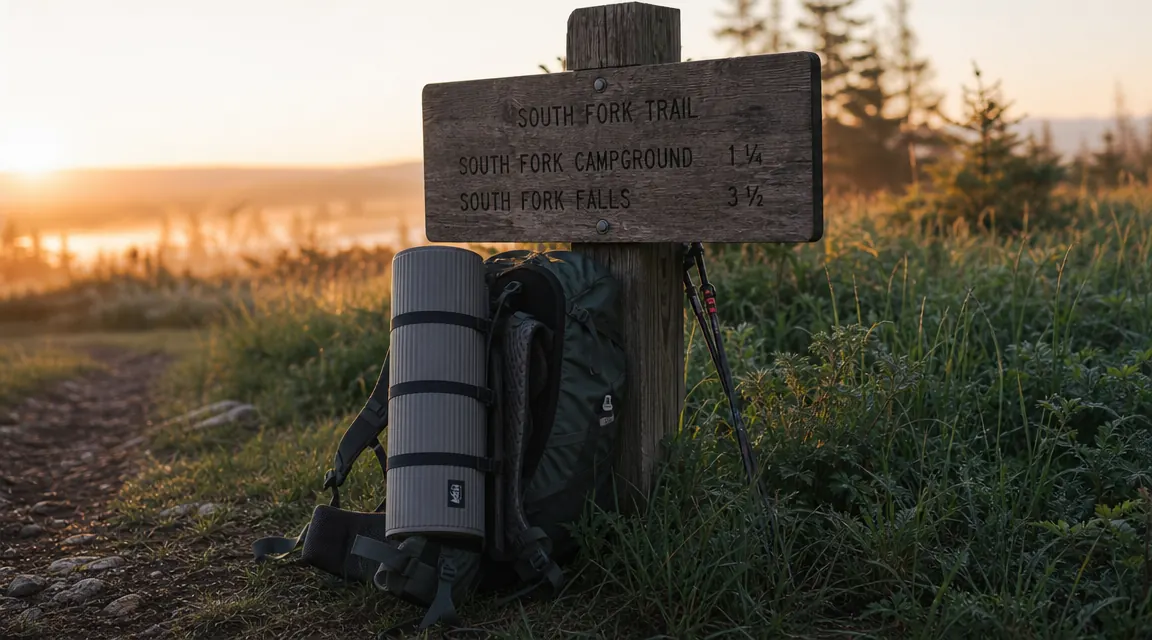
Here is where I have to be straight with you. The Artemis weighs 4 pounds 6 ounces. Rolled up with its carry bag, it measures roughly 12 inches long and 6 inches in diameter. For car camping, that's completely acceptable. It fits easily in the back of an SUV or truck bed, rolls up in about 45 seconds, and the carry bag has a shoulder strap that makes it portable enough for a short hike-in camp.
For backpacking, it's a different story. Most backpackers targeting multi-day trips aim for a total base weight under 20 pounds, and a sleeping pad above 4 pounds is a significant portion of that budget. Comparable insulation on purpose-built backpacking pads, like the Therm-a-Rest NeoAir XTherm at R-7.3, weighs 15 ounces and packs to the size of a 1-liter water bottle. You pay roughly three times more for that performance-to-weight ratio. The Artemis is not competing with those pads. It's competing with car camping and casual overnight pads in the $80 to $150 range, and at that weight and insulation level, it's a strong value.
If your camping style involves loading up a minivan and driving to a state park, the weight doesn't matter. If you're counting ounces for a five-day ridgeline traverse, look elsewhere.
What I Liked
- 8.3 R-value performs credibly in sub-30-degree overnight conditions
- 3-inch loft is thick enough to cushion hips and shoulders on firm ground
- Twist valve is easy to operate with gloves on in cold temperatures
- Included pillow attaches securely and removes a packing-list item
- Patch kit included means minor punctures are fixable in the field
- Comfortable 25 by 77-inch footprint fits most adult sleepers
- Self-inflating foam construction means no pump required
Where It Falls Short
- 4 pounds 6 ounces is too heavy for serious backpacking
- Rolled diameter of 6 inches takes up meaningful pack space
- Needs 2 to 3 manual breaths to reach full firmness after self-inflation
- No R-value certification listed from an independent testing lab
- Top fabric develops a faint musty smell after multiple damp conditions without thorough drying
Durability After Six Months
I've opened and rolled this pad roughly 18 times across six trips, plus several backyard tests and one outdoor photography session. The seams are intact, the valve shows no cracking, and the exterior fabric hasn't developed any of the fuzzing or delamination I've seen on cheaper pads after comparable use. The two fabric layers, a smooth top and a slightly textured bottom, have held their finish.
On trip four, I noticed a faint musty smell when I first unrolled it after storing it damp. That's user error, not a pad defect. The instructions say to store it unrolled and unzipped, which I hadn't done. Once I aired it out for 24 hours the smell cleared. Self-inflating pads with open-cell foam cores need to breathe between uses. If you store it compressed in its carry bag for two months, expect to air it out before your next trip.
The patch kit that came in the box is a standard peel-and-stick repair kit. I haven't needed it yet, but on one trip I noticed a small scratch across the bottom fabric from a sharp pebble under the tent floor. It didn't go through to the foam, so no repair was needed. I'd recommend a groundsheet or footprint if you're camping on rocky terrain.
How It Compares to Similar Pads
The most direct comparison in the same price range is the Klymit Insulated Static V Lite, which has an R-value of 4.4, weighs 26 ounces, and packs down significantly smaller. The Klymit wins on weight and packability by a wide margin. The Artemis wins on insulation by a similarly wide margin. If you camp year-round in temperatures below 40 degrees, the Artemis's thermal advantage is meaningful. If your camping season runs May through September and your coldest night is 45 degrees, the Klymit's packability might matter more to you. I go deeper on that comparison in the Gear Doctors Artemis vs Klymit Static V comparison if you want the full breakdown.
Against foam mats, the Artemis is in a different category entirely. A 3/8-inch closed-cell foam mat has an R-value of around 2.0 and costs $15 to $30. It's bomber-durable and essentially weightless at under 14 ounces. But the insulation gap between R-2 and R-8.3 is not theoretical. On a 29-degree night, that gap is the difference between sleeping and not sleeping. If you want to understand the full case for self-inflating pads over foam, I've laid it out in 10 reasons a self-inflating pad beats a foam camp mat.
Who This Is For
The Gear Doctors Artemis is a strong buy for car campers and drive-in campers who sleep in temperatures below 40 degrees and want serious ground insulation without paying $250 to $400 for a name-brand four-season pad. It's also a good fit for campers who don't want to fuss with a pump, who like the convenience of a self-inflating system, and who camp frequently enough to justify a pad that lasts. The included pillow makes it a particularly good value for solo campers who want to consolidate gear.
It also suits couples buying two pads for a shared tent on shoulder-season trips. At $104.99 per pad, two Artemis pads cost less than one premium backpacking pad from the big brands, and for car camping, the weight difference is irrelevant. That's a compelling value proposition for families or partners who camp four to eight times a year.
Who Should Skip It
Skip this pad if your primary camping style involves multi-day backpacking where every ounce in your pack matters. At 4 pounds 6 ounces, the Artemis would eat a large chunk of any reasonable backpacking weight budget. You'd be better served by a lighter inflatable pad even if it costs more upfront.
Also skip it if you camp exclusively in warm weather, say, May through early September in the southern US, and your overnight temperatures rarely drop below 50 degrees. You'd be paying for an R-value you don't need. A lighter 3-season pad in the $60 to $80 range would serve you just as well and take up less room in the car.
If cold ground kept you up last season, the Artemis solves that problem for a fraction of what four-season pads usually cost.
4.5 stars from 4,783 verified buyers on Amazon. Gear Doctors backs the pad with their standard warranty and includes a patch kit. Check today's price before your next trip.
Amazon Check Today's Price on Amazon →