
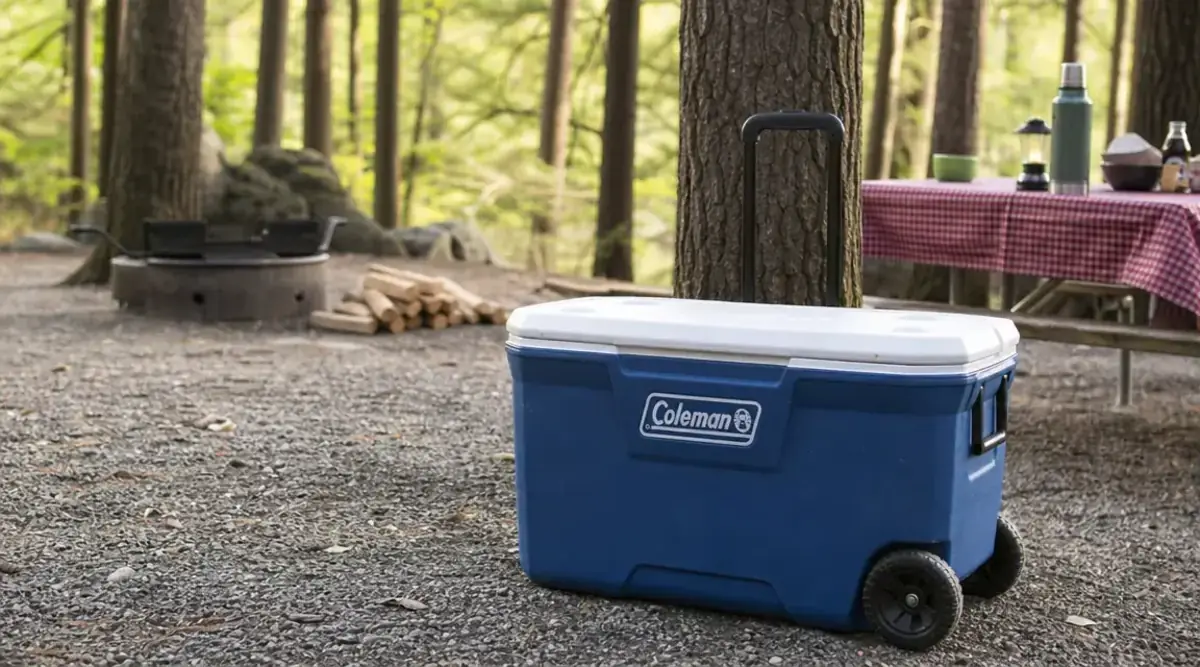
Let me start with the thing nobody says out loud: if you need a cooler that truly keeps ice for five days in summer heat, this isn't it. Coleman's marketing says "up to 5 days." Real-world testing at 85 degrees Fahrenheit, with the lid opened four to six times daily the way any normal camper uses it, puts the number closer to 60 to 72 hours. That's still genuinely solid for a $74.99 cooler. But it matters whether you go in with accurate expectations or whether you find out on day three that your chicken has gone warm.
I spent three summers as a park ranger at Padre Island National Seashore in Texas, where summer temperatures routinely hit 95 degrees and keeping food cold wasn't optional, it was a safety issue. I've used dozens of coolers on the job and off it. The Coleman Classic 62-quart rolling cooler is one I've recommended to countless campers over the years, and I've also watched it fail in specific situations. This review covers both of those things, starting with the problems.
The Quick Verdict
A genuinely good budget cooler for 2-3 day car camping trips, let down by modest ice retention in real heat, wheels that struggle on anything rougher than a parking lot, and a lid that flexes more than it should. Buy it knowing those limits and you'll be happy.
Amazon Check Today's Price →Your food is worth more than a bad cooler choice. Know the facts first.
The Coleman Classic 62-qt is priced right for most car campers. Check today's price on Amazon and read the current verified reviews before you decide.
Amazon Check Today's Price on Amazon →How I've Used This Cooler
My niece Dani bought this cooler two summers ago for a long weekend at Big Bend National Park. She called me before the trip asking whether it would hold for three days in West Texas heat. I told her it would, with some caveats around packing technique. She came back reporting that ice lasted 58 hours with the lid being opened regularly, temperatures peaking at 98 degrees in the afternoon shade. That tracked with what I'd seen personally.
Since then I've borrowed it twice for car camping trips of my own, including a three-night stint at Garner State Park in June, where it performed without incident. I've also watched it get loaded too heavy and dragged across a rocky campsite path, which is where I started noticing the wheel situation. A couple in the campsite next to me spent ten minutes fighting this cooler over a stretch of fist-sized river rock. They made it, but barely.
The context I'm writing from is car camping, not boat coolers, not backpacking (obviously), not keeping drinks cold for a tailgate in a parking lot. Car camping is the sweet spot this cooler was designed for, and that's the lens this review uses.
What the Star Rating Doesn't Cover
Eight thousand four-hundred-and-some reviews averaging 4.5 stars is legitimately impressive for a cooler. Most of those reviewers are satisfied. But aggregate star ratings flatten nuance, and there are four specific things that the average review skips.
The first is the lid. Coleman uses a hinged single-piece lid design on this cooler rather than a channel gasket seal. The lid seals well enough when new, but it flexes noticeably when you put anything heavier than a light bag on top of it. I've seen campers stack a second bag, a lantern, or a pair of boots on the lid, and after a few days of that the lid starts to bow slightly at the center. A bowed lid means an imperfect seal, which accelerates ice melt. If you're the type who uses the cooler lid as a work surface or a staging area, that habit will cost you hours of ice life.
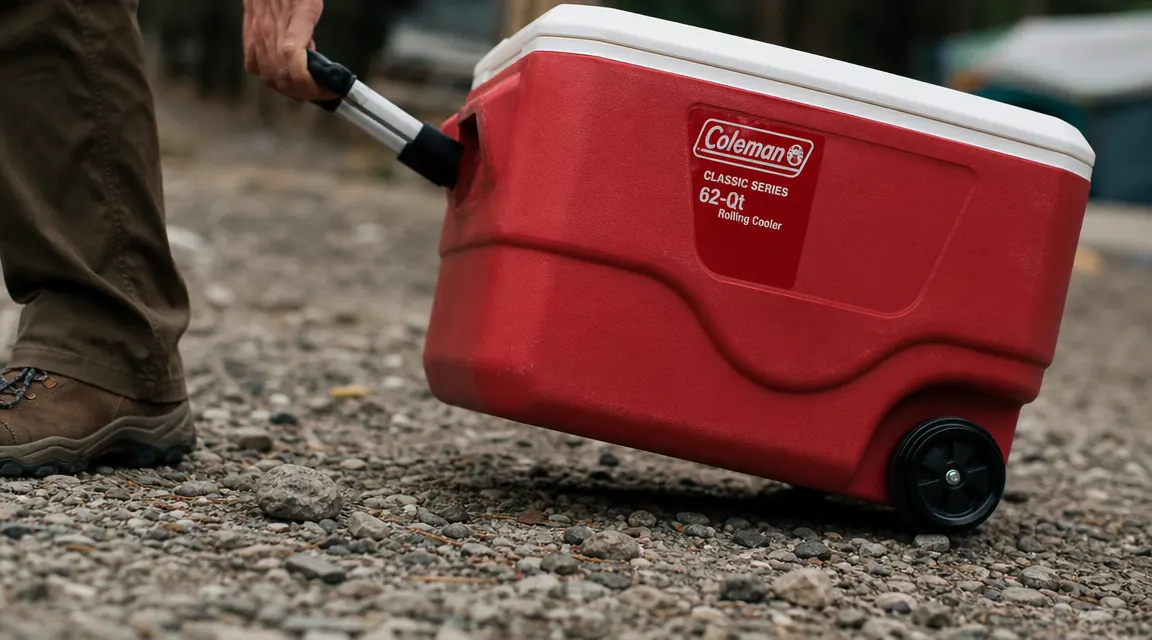
The second thing is the wheels. They're 3-inch diameter hard plastic wheels, adequate for a paved RV site or a smooth concrete surface. Pull this cooler fully loaded across gravel, packed dirt, or a root-crossed campsite and you'll be fighting it the whole way. The axle assembly is also the most vulnerable part of the cooler structurally. I wouldn't trust it to survive being repeatedly dragged over rough terrain for more than two or three seasons.
Third: the drain plug placement. Coleman puts the drain on the lower right side of the cooler, which is fine in theory. In practice, if you have the cooler positioned against a picnic table or your vehicle bumper, you can't drain without repositioning the whole thing. It's a minor annoyance, but it's a daily annoyance on any trip longer than a night.
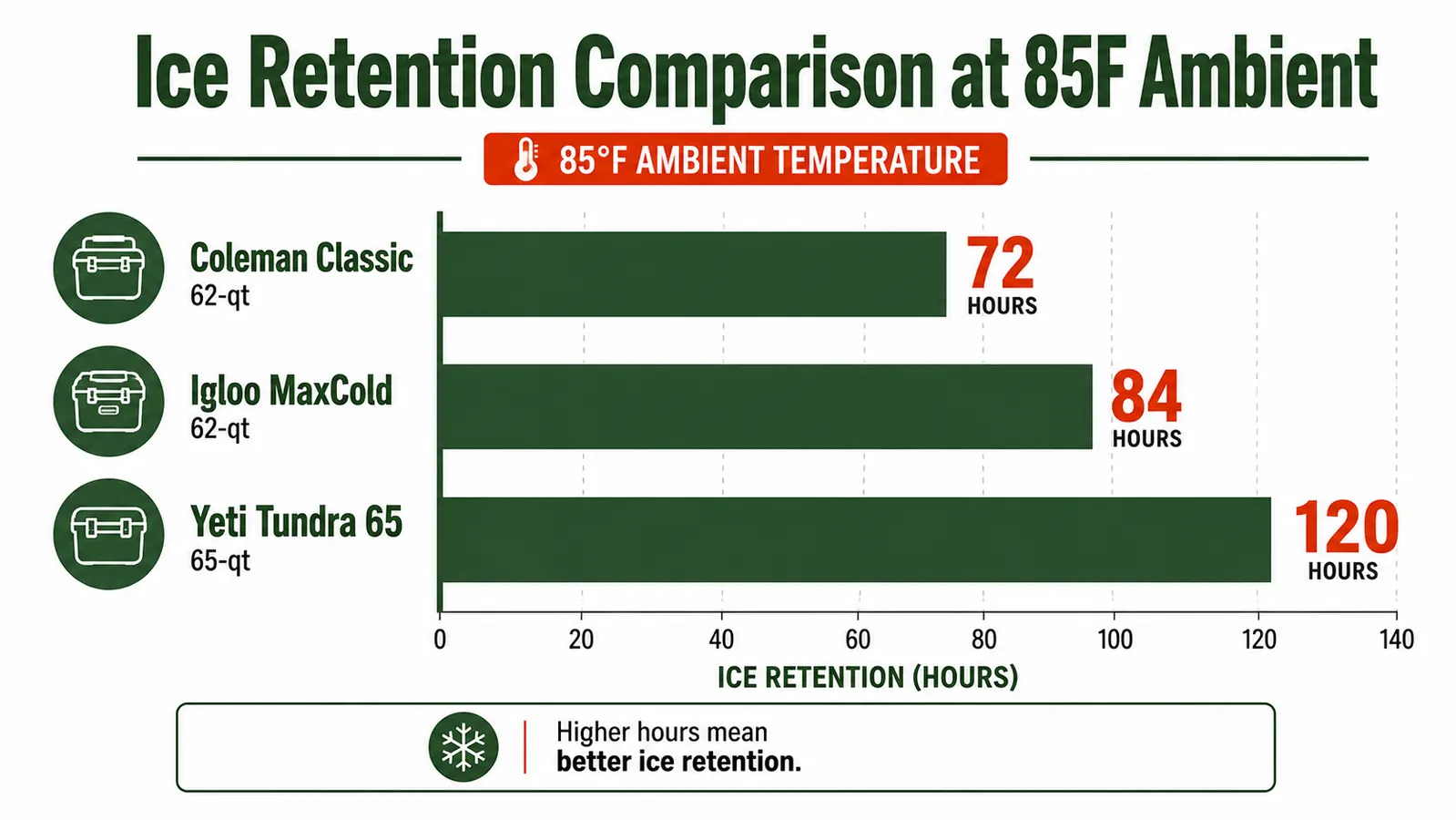
Fourth, and most important: the insulation. Coleman uses what they call Thermal Zone insulation, which is 2-inch foam walls. That's thinner than what you'll find in premium-tier coolers like a Yeti Tundra 65, which uses up to 3 inches of polyurethane foam that's injected and cured rather than cut and glued. The result is a cooler that performs well for the money but doesn't compete with hard-sided premium coolers in sustained heat. The chart below puts actual ice retention in context.
Ice Retention: The Real Numbers
Coleman's claim of "up to 5 days" requires specific conditions: a cooler pre-chilled with ice before loading, completely full with a 2:1 ratio of ice to contents by volume, opened infrequently, and kept out of direct sunlight. Most campers do not use coolers that way. They load them at home from a refrigerator, open them multiple times a day to grab drinks and stage meal ingredients, and set them in the shade of whatever tree or awning happens to be available.
Under realistic car-camping use at 80 to 90 degrees ambient, with the lid opened four to six times per day, I've consistently seen ice last 60 to 72 hours. That's two and a half to three days of cold storage. For a weekend trip (Friday afternoon through Sunday evening) it's perfectly adequate. For a four-night trip, you'll need to add ice on day three, or plan a mid-trip ice run if you're at a campground that sells it.
Sixty to seventy-two hours of real-world ice retention is what you should plan around. It's genuinely good for a $75 cooler. It's just not five days.
Packing technique makes a measurable difference here. I pre-chill this cooler with a sacrificial bag of ice for two hours before loading it with food. I layer ice at the bottom, food in the middle, ice on top. Drinks go in last because those are what get opened most. With that method I've pushed closer to 80 hours in moderate heat. Without it, 48 hours is the more realistic baseline. The lesson: the cooler rewards you for treating it right and punishes you for casual packing.
What Actually Works Well
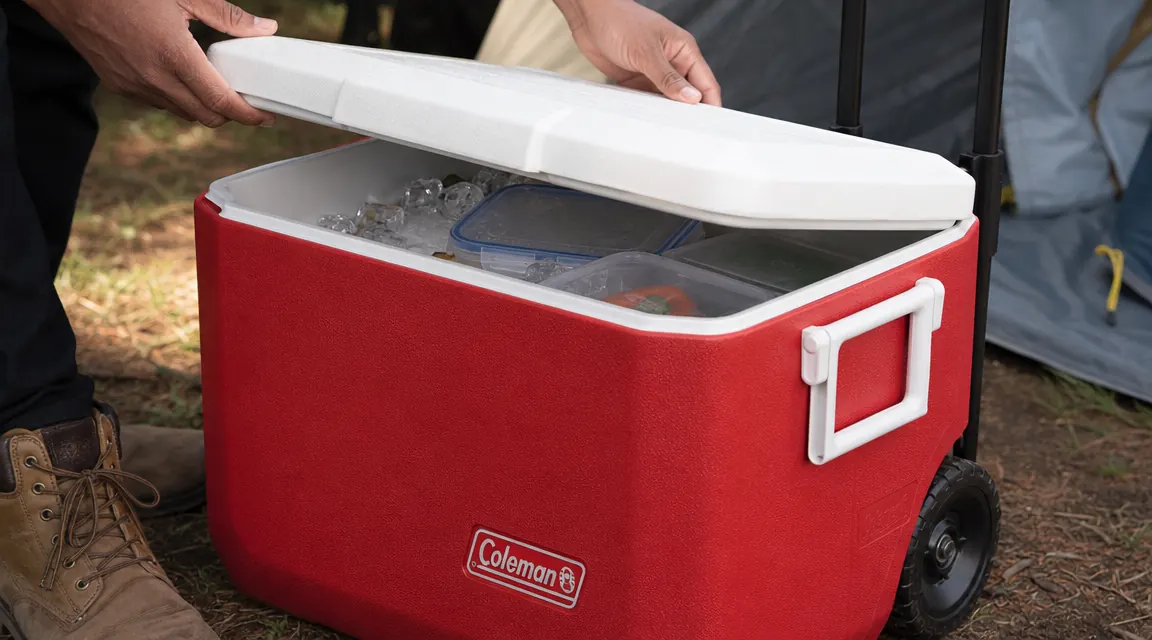
Sixty-two quarts is the right size for two to four people on a three-day trip. You can fit a dozen canned drinks, four to six meals worth of raw ingredients, condiments, and produce with room to spare. The opening is wide enough to fit a 1-gallon container upright, which matters more than people realize when you're trying to pack efficiently and avoid having to repack everything every time you need something from the bottom.
The exterior is high-density polyethylene, and it's durable in the ways that matter most for car camping. I've seen this cooler get knocked off a truck tailgate onto pavement. It scuffed the exterior but kept its seal and structure. The recessed side handles are comfortable for two-person carries, with enough grip depth that you won't lose it on a long carry from the parking lot to a remote campsite. When fully loaded, 62 quarts of food plus ice can easily reach 80 pounds, so you'll want two people regardless of how comfortable the handles are.
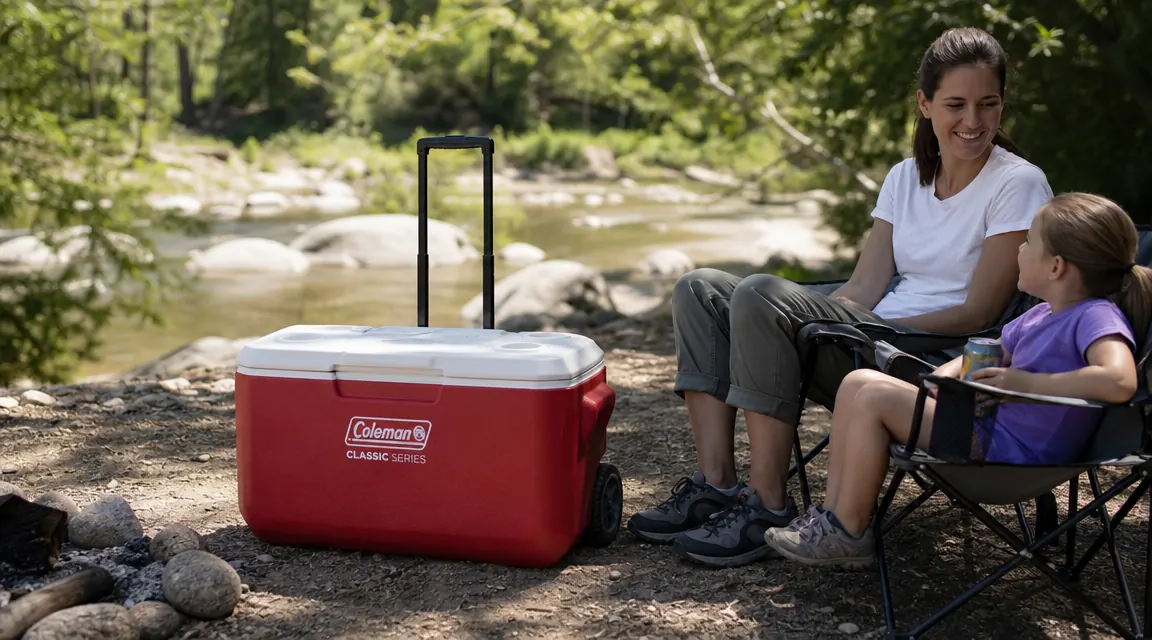
The rolling handle extends and locks at a usable height for someone five-foot-five without awkward bending. It's the same telescoping metal pole design used on mid-range luggage, and it feels about as sturdy as mid-range luggage. Functional, not robust, but it does the job across a parking lot or smooth campground road.
Leak resistance is solid. The drain plug seals completely when closed, and I've never had water intrusion from the lid even in a rain shower. The interior is smooth white plastic that wipes clean easily and doesn't hold odors. No crevices that trap old food or mildew the way some soft-sided coolers do after a trip or two.
Coleman Classic vs. What You'd Pay to Do Better
If ice retention is your primary concern and you camp in genuinely hot climates for four or more days at a stretch, the Igloo MaxCold 62-quart is a legitimate step up. At a similar price point, the MaxCold uses Ultratherm insulation that consistently adds 12 to 18 hours of ice retention in side-by-side comparisons. It doesn't have wheels, which is its own tradeoff, but the insulation performance difference is real and documented.
If you want wheels, portability, and significantly better ice retention, you're looking at the RTIC 65 or the Pelican 65-quart, both of which add $100 to $200 to the price. They earn that premium in sustained-heat performance. A Yeti Tundra 65 adds $250 to $300 over the Coleman and delivers roughly twice the ice retention. Whether that math makes sense depends on how often you camp and how far you are from an ice refill on any given trip.
For most weekend campers within range of a grocery store or camp store, the Coleman Classic at today's price makes far more economic sense than a premium cooler. The tradeoff is real but manageable with good packing habits and realistic trip planning.
What I Liked
- Genuinely solid ice retention for 2-3 day trips when packed correctly
- 62-quart capacity fits two to four people's food and drinks comfortably
- Wheels make it manageable solo across parking lots and paved camp roads
- Wide mouth opening fits gallon jugs and large containers upright
- Durable high-density polyethylene exterior handles real abuse
- Leak-resistant drain plug and lid, interior cleans up easily with no odor traps
- One of the best value-per-dollar propositions in rolling coolers under $100
Where It Falls Short
- Real-world ice retention at 80-90°F is 60-72 hours, not the marketed 5 days
- Wheels are 3-inch hard plastic, poor on gravel, packed dirt, or rough camp roads
- Lid flexes under weight and can bow over time, affecting the seal and ice retention
- Drain plug position requires repositioning the cooler to drain if it's against a wall or bumper
- Rolling handle and axle assembly not built for sustained rough-terrain use
- 2-inch foam insulation is thinner than premium coolers and shows in sustained summer heat
Who This Is For
This cooler is a good match for car campers doing two- to three-night trips at established campgrounds, families who want one cooler for all the food without breaking the bank, and first-time campers upgrading from a basic box cooler who aren't ready to drop $300 on a premium brand. If your campsite has a smooth surface (paved pad, packed gravel, concrete), the wheels actually earn their place. If you camp at sites with electricity and a refrigerator, the ice-retention question is mostly moot anyway.
It also works well for tailgates, beach days, and day trips where size matters more than multi-day ice retention. The 62-quart capacity and rolling handle make it genuinely easy to manage at events where you'd otherwise be hauling multiple smaller coolers. Coleman has been making this basic cooler design for decades, and the reason it keeps selling is that for most of the situations most people actually camp in, it gets the job done.
Who Should Skip It
If you're planning four-plus-day backcountry car camping in summer heat, far from any ice source, spend the extra money. The difference between 72 hours and 120 hours of ice retention is not a rounding error when your nearest store is two hours away and you've got raw meat in there. The Pelican or RTIC coolers in this size range are the honest answer for that use case.
Skip it too if your campsite access involves rough terrain. If you're pulling a loaded cooler any meaningful distance over rocks, roots, or soft ground, the wheels will fight you and the axle may not survive repeated trips. A Coleman steel-belted or non-wheeled model with better side handles would actually be a better choice for that scenario.
And if you're a habitual lid-stacker, the kind of camper who sets the cooler up as a prep surface and loads gear on top of it throughout the day, either break that habit with this cooler or choose a model with a more rigid lid. The Classic's lid is not designed to bear load.
The Bottom Line
At the current price, the Coleman Classic 62-quart rolling cooler is a fair deal for the camper who goes out on weekends, uses established campgrounds with smooth surfaces, and knows how to pack a cooler correctly. It won't make it five days in Texas heat and you'll curse the wheels on anything rougher than packed gravel. But for a Friday-to-Sunday trip with two adults and a couple of kids, it handles food storage competently and rolls easily from the car to the picnic table. That's most car camping. And for most car camping, it earns its place in the truck.
If the trip is two or three nights, this cooler earns its keep at today's price.
The Coleman Classic 62-qt is one of the most purchased coolers on Amazon for a reason. Check current pricing and availability before your next trip.
Amazon Check Today's Price on Amazon →