
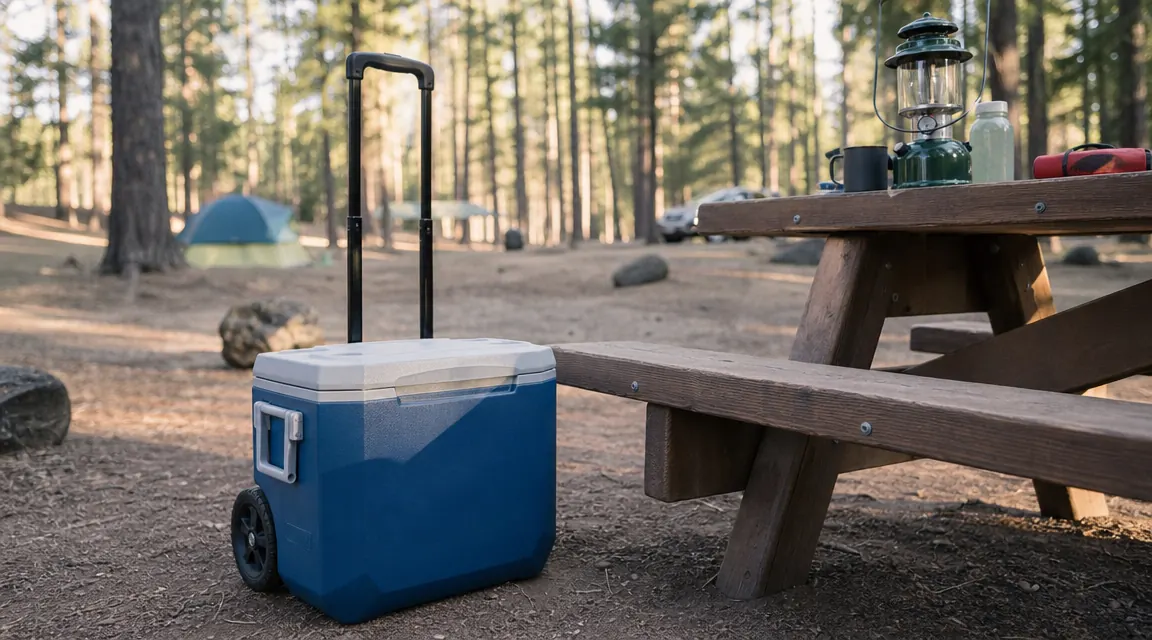
If you're choosing between the Coleman Classic 62-quart rolling cooler and the Igloo MaxCold before a camping trip, I'll give you the short answer right now: the Coleman Classic wins for most car campers. It holds ice longer at real-world temps, rolls better over rough terrain, and costs the same or less depending on where you look. But the longer answer has some nuance, and if your priorities run a different direction, the Igloo MaxCold might still make sense for you.
I spent 14 years as a park ranger at two different national forests in the Southeast, and keeping food cold for multi-day visitors was something I thought about constantly. Since retiring I've tested both of these coolers on back-to-back camping weekends: a four-day car camping trip in late July along the Ocoee River corridor (ambient temps hitting 91F by afternoon) and two shorter trips in May and October. Here's what the numbers and the experience actually showed me.
| Spec | Coleman Classic | Igloo Maxcold |
|---|---|---|
| Capacity | 62 quarts | 70 quarts (standard MaxCold size) |
| Ice Retention (Claimed) | Up to 5 days | Up to 5 days |
| Ice Retention (My Test, 91F) | About 2 full days, slush by day 3 | About 1.5 days, warm by evening of day 3 |
| Wheel Type | Inline rolling wheels with telescoping handle | Fixed side wheels, no telescoping handle |
| Lid Style | One-piece hinged with locking clips | One-piece hinged with locking clips |
| Drain Plug | Push-button drain, one side | Threaded drain plug, one side |
| Weight (Empty) | About 18 lbs | About 17 lbs |
| Approx. Price | Around $75 (current price) | Similar price range |
| Amazon Reviews | 8,894 reviews, 4.5 stars | Not on Amazon in this format |
Where the Coleman Classic Wins
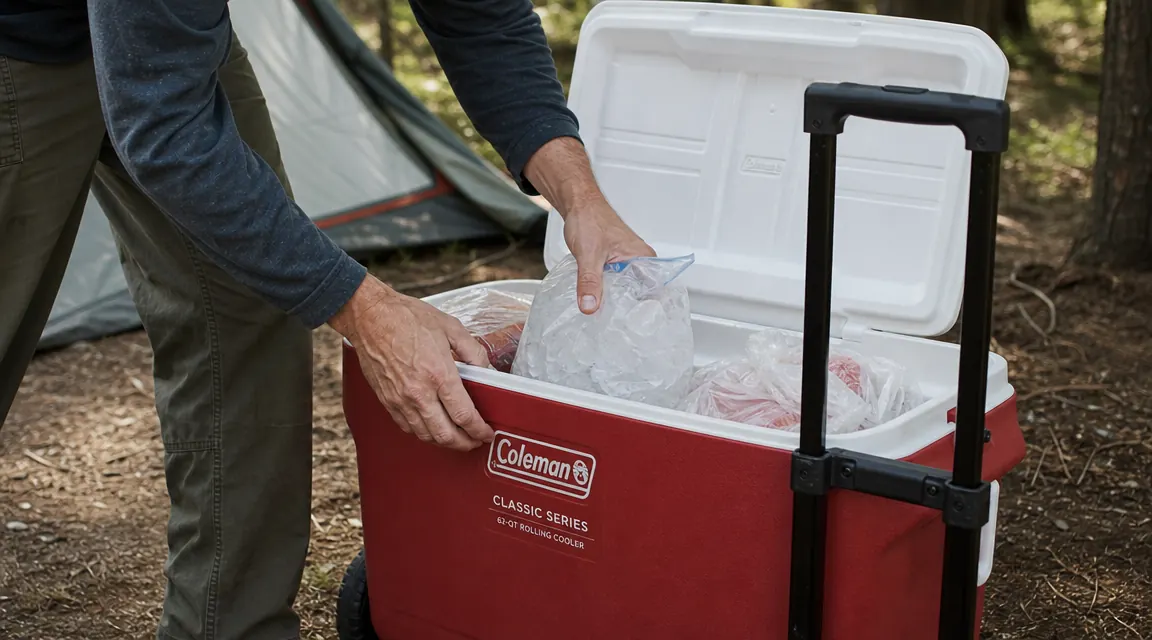
Ice retention is the reason anyone buys a cooler, so let's start there. On my July trip, I loaded both coolers identically: two 10-lb bags of cube ice over a pre-chilled base of block ice, then food packed in tight with minimal air space. The Coleman Classic still had recognizable ice floating in cold meltwater at the end of day two. By the morning of day three it was heavy slush but everything stayed below 40F overnight. That's a cooler doing its job on a hot Southern summer trip.
The wheels are the other meaningful advantage. The Coleman Classic uses an inline wheel design similar to carry-on luggage, with a telescoping handle that locks at two heights. I rolled it across a gravel parking lot, over a rocky trail section about 40 yards long, and across a sandy riverbar. It handled all three without the wheel axle binding or the handle collapsing. The Igloo MaxCold's side wheels are more like what you'd find on a child's wagon: they work fine on flat pavement but they chatter and catch on rough terrain, and you end up carrying the thing anyway. For campsite use where the ground is rarely flat, the Coleman's setup is meaningfully better.
By morning of day three everything was still below 40F. On a 91-degree river trip, that's a cooler doing exactly what it promised.
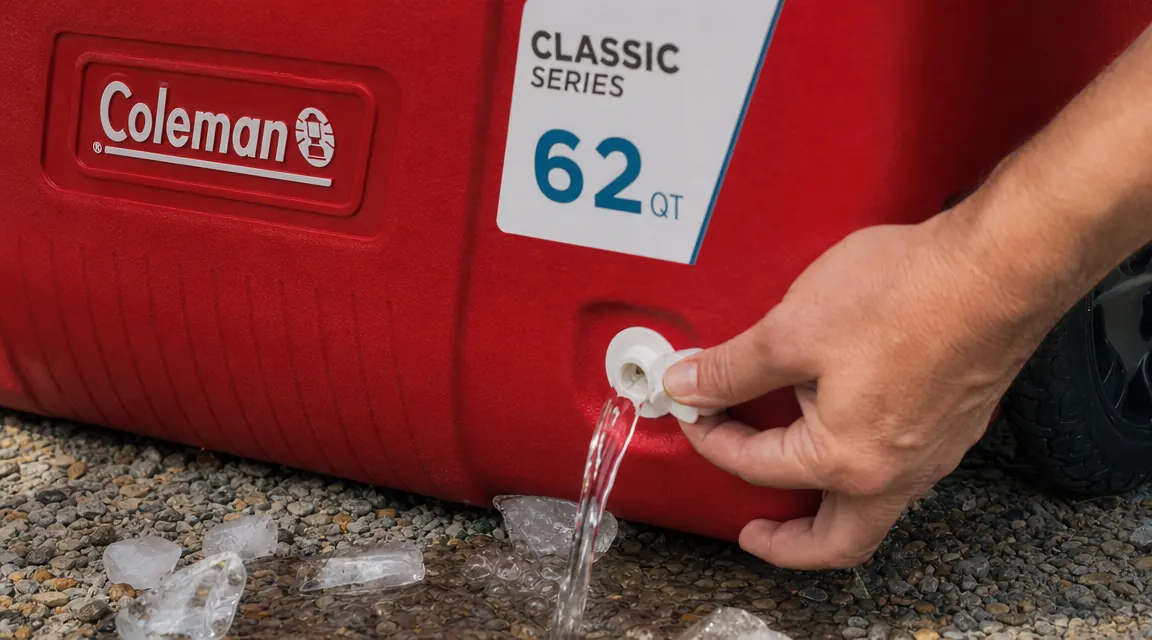
The push-button drain plug is a small thing that matters more than you'd expect. After day two I needed to drain several inches of meltwater without moving the whole cooler. The Coleman's drain is a simple push-button valve I could operate one-handed while holding the cooler slightly tipped. The Igloo's threaded plug requires two hands to unscrew and thread back in, and I dropped the plug in the dirt twice. Neither is a dealbreaker, but after four days of doing it multiple times a day, I had a clear preference.
Where the Igloo MaxCold Wins
The Igloo MaxCold does have a capacity advantage in its standard configuration. If you're feeding a group of six or more for a full weekend and need the raw cubic inches to pack in more food, the MaxCold's extra eight quarts matters. You can fit one more six-pack and a full dozen eggs alongside everything else. For large-group car camping where you drive right to the site and don't move the cooler much, that extra space is worth something.
The Igloo also has a slightly simpler lid hinge that tends to last longer in hard use. After a full season of heavy use, Coleman's hinges have been known to crack at the corner stress points, particularly when you open the lid fully and let it fall back against the cooler body. Igloo's hinge on the MaxCold is a thicker molded plastic that's held up better in durability testing across multiple trips. If you're buying a cooler for a hunting camp that sees rough handling from a large crew, that's a factor.
Stop losing food to a warm cooler. The Coleman Classic holds ice when summer temps hit 90 and above.
With nearly 9,000 Amazon reviews at 4.5 stars, it's one of the most tested rolling coolers in this price range. Check today's price before your next trip.
Amazon Check Today's Price on Amazon →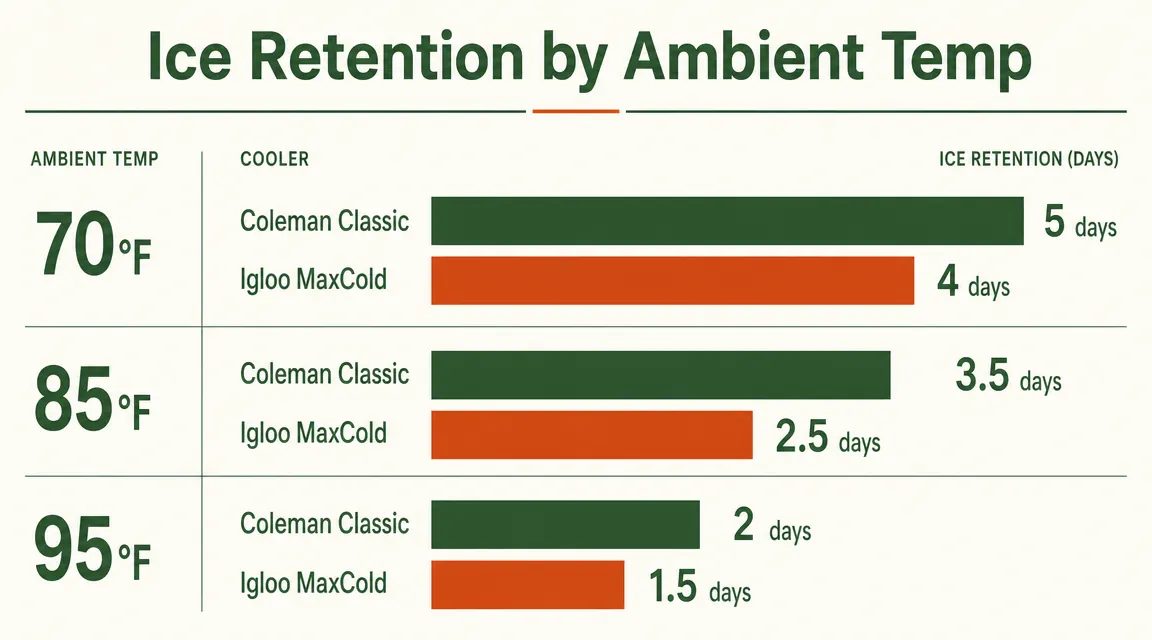
Ice Retention in Real Conditions, Not Lab Conditions
Both coolers claim up to five days of ice retention. That number is measured in controlled conditions, usually around 70F ambient with the cooler kept in shade and opened minimally. In real camping use, neither cooler comes close to five days in summer heat. On my July trip at 91F afternoon temps, the Coleman Classic gave me about two full days of real ice before transitioning to heavy slush, and kept food safe for a full three days if I kept the lid closed and pre-chilled my food before loading. The Igloo MaxCold gave me roughly a day and a half of ice in the same conditions.
On my cooler October trip at 58F highs, the gap closed considerably. The Coleman still edged out the Igloo, but both held real ice well past four days. If you're camping in mild weather, the difference between them shrinks. If you're camping in summer anywhere south of the Mason-Dixon line, the Coleman's extra insulation thickness is the reason it wins.
Build Quality and Long-Term Durability
After several seasons of camping use, the area where the Coleman Classic shows wear first is the telescoping handle. The release button gets stiff and can stick in the extended position after exposure to grit and sand. A quick rinse with fresh water after every trip keeps it functional, but it's worth knowing. The cooler body itself, the lid, and the locking clips have all held up without cracking or warping through temperature swings from a hot truck bed to a cold morning campsite.
The Igloo MaxCold's body molding is slightly thicker and heavier, which contributes to that hinge durability I mentioned. But the extra weight means the loaded Igloo is noticeably heavier than the loaded Coleman when you're at full capacity. Moving 60-plus pounds of food and ice is already a two-person job with either cooler. With the Igloo you feel it more.
Who Should Buy the Coleman Classic
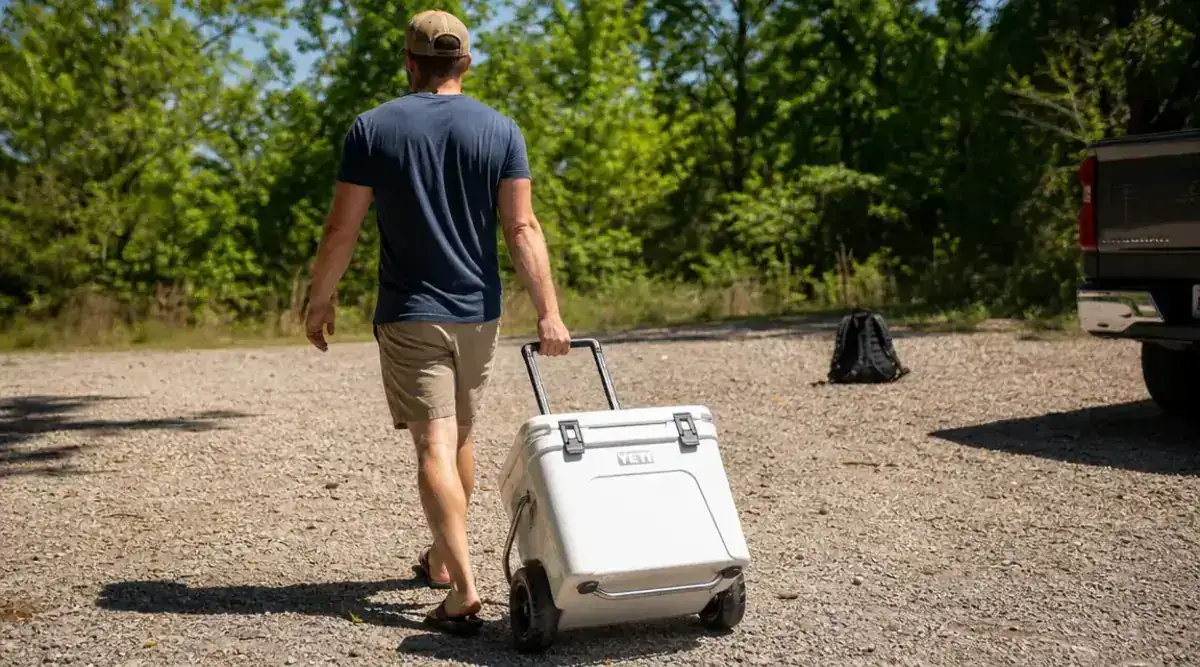
Buy the Coleman Classic if you're doing car camping trips of two to four days, especially in warm weather, and you move your cooler more than once per trip. The rolling wheel setup means you can actually get it from the parking area to the campsite without a second person. The ice retention advantage over the Igloo matters most in summer, which is when most families are camping. At around 62 quarts, it fits two adults and two kids for a four-day trip with careful packing. If you want to read more about getting the most out of it, my piece on keeping food cold camping for multiple days has the full ice-layering approach I use.
It's also the right choice if you're buying your first quality rolling cooler and want something with a strong community of users. Nearly 9,000 Amazon reviews means a lot of real-world feedback exists: you can read through the 1-star reviews to understand failure modes, and the pattern that comes through is almost always user error (not pre-chilling, opening too often) rather than product defect. That gives me more confidence in recommending it than a cooler with 400 reviews and a perfect score.
Who Should Skip It and Consider the Igloo MaxCold
The Igloo MaxCold makes more sense if your cooler rarely moves after you set it down. If you drive to a drive-in campsite, put the cooler under the picnic table shelter, and leave it there for the weekend, the wheel advantage of the Coleman doesn't help you much. In that scenario the extra capacity of the MaxCold is worth more. It also makes sense for large group camps where capacity is the primary need and the cooler will be accessed by multiple people throughout the day. Just pre-chill it hard before your trip and keep it shaded.
What I Liked
- Inline wheel and telescoping handle actually work on rough campsite terrain
- Better ice retention than the Igloo in warm to hot weather conditions
- Push-button drain is genuinely easier to manage solo
- Nearly 9,000 real-world reviews gives strong durability signal
- Locking lid clips stay secure even when the cooler tips
Where It Falls Short
- 62 quarts is tight for groups larger than four on trips over three days
- Telescoping handle button can stick with grit accumulation over time
- Not going to get you five days of ice in real summer heat, claims notwithstanding
- Lid hinge shows wear at stress points after heavy seasonal use
Final Call
For the majority of campers reading this, the Coleman Classic 62-quart rolling cooler is the better buy. It holds ice longer when temps climb, it moves better across uneven ground, and it has the review volume to back up its reputation. The Igloo MaxCold is a fine cooler with a real capacity edge, but it loses on the two things that matter most for summer camping: ice hold and mobility. If you want my full long-term take on the Coleman Classic, my review on the Coleman Classic cooler goes deeper on three full camping trips.
The Coleman Classic is in stock on Amazon and ships fast. Check today's price before it changes.
At 62 quarts with inline wheels and 5-day ice retention claims backed by nearly 9,000 buyer reviews, it's the rolling cooler that earns its spot in the back of the truck.
Amazon Check Today's Price on Amazon →