
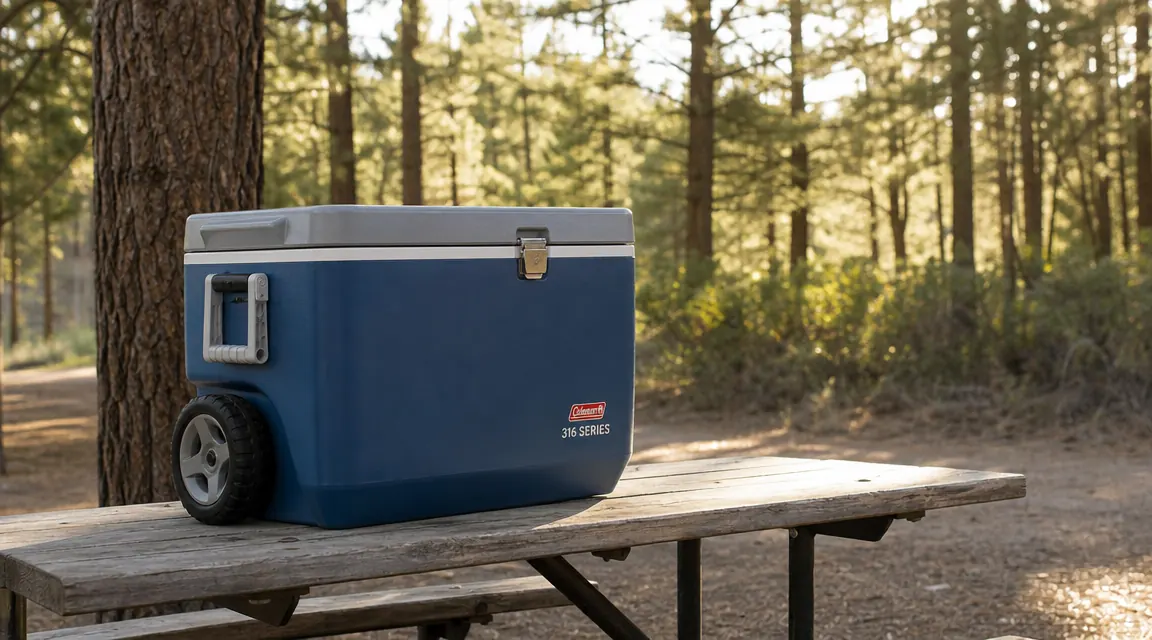
Last July, my friend Dana and I spent four days at a dispersed site outside of Bend, Oregon. Temperatures pushed into the mid-80s during the day and dropped to around 58 degrees at night. We brought a 48-quart cooler that I had used for years, and by the morning of day three, our ground beef was sitting in cold water that had stopped being cold twelve hours earlier. We ate out that night. The drive home the next day was a silent reckoning with the fact that I had been tolerating a mediocre cooler for far too long.
The Coleman Classic Series 62-Qt Rolling Cooler was already in my garage by the following weekend. I had seen it near the top of Amazon's best-sellers list with 8,894 reviews and a 4.5-star rating, and at current pricing it sits well below what most premium rotomolded coolers cost. I have now taken it on three separate car camping trips over the past eight months. This review covers what I found, including where Coleman's marketing holds up and where it quietly falls short.
The Quick Verdict
A genuinely solid car camping cooler that delivers real 4-to-4.5-day ice retention when you pack it right. The wheels and telescoping handle are the best features. The thin lid and noisy drain plug are the two legitimate complaints.
Amazon Check Today's Price →If your food is going warm on day two, this cooler is the fix for under $80.
The Coleman Classic 62-Qt has over 8,800 reviews and currently sits under $75. It holds a full weekend's worth of food for two adults with room for beer.
Amazon Check Today's Price on Amazon →How I Tested It
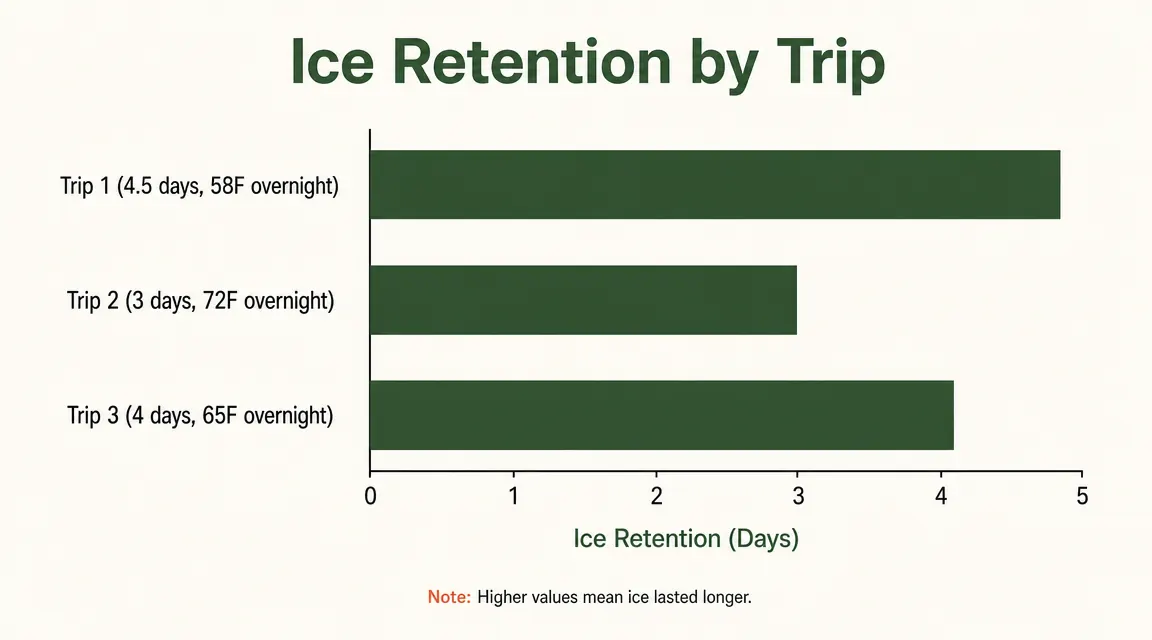
I used the Coleman Classic on three separate trips between August 2025 and April 2026. Trip one was a four-night dispersed site in central Oregon at elevation (around 4,200 feet), with daytime highs of 82 degrees and nights around 58. Trip two was a three-night campground stay in the Cascades foothills in late September, warmer nights, about 72 degrees by my camp thermometer. Trip three was a long weekend in the Columbia River Gorge in April, with 65-degree nights and overcast days that kept daytime temps from climbing past 68.
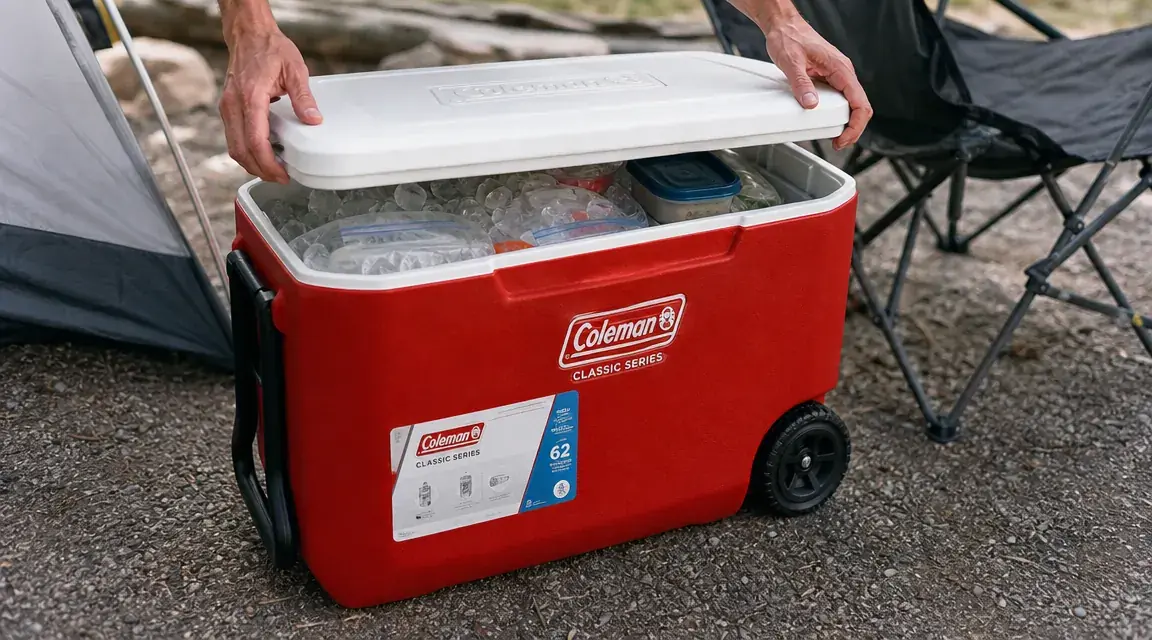
On each trip I packed the cooler the same way: a two-inch layer of cubed ice on the bottom, then food in zipper bags and hard-sided containers, then another layer of ice over the top, with one 10-pound block of ice buried in the center. I never opened the cooler more than two or three times a day. I placed it in the shade whenever possible, which was most of the time at wooded Pacific Northwest sites. The cooler was pre-chilled the night before each departure by filling it partway with ice and draining it before the real load went in.
I was not trying to game the ice retention test in Coleman's favor. I packed it the way a competent camper packs a cooler. Those are the conditions where a cooler has to earn its keep.
Ice Retention: What Actually Happened
On trip one, I had usable ice (not just cold water) through the afternoon of day four, which works out to roughly 4.5 days from the time I sealed it up. That is right at the edge of Coleman's five-day claim, and I will give them credit for it, though those were favorable conditions with cool nights. On trip two, with warmer overnight temps, ice was gone in just over three days. On trip three, the overcast cool-day conditions pushed me back up to almost four days of ice.
The pattern is consistent with what the insulation is actually capable of: roughly one inch of foam in the walls and lid. That is enough for 4 to 4.5 days in genuinely cool conditions, and about three days when nights stay warm. If you are camping in Florida in August, adjust your expectations downward. If you are in the Pacific Northwest or camping in the mountains, Coleman's five-day claim is within reach.
What I Like About the Build
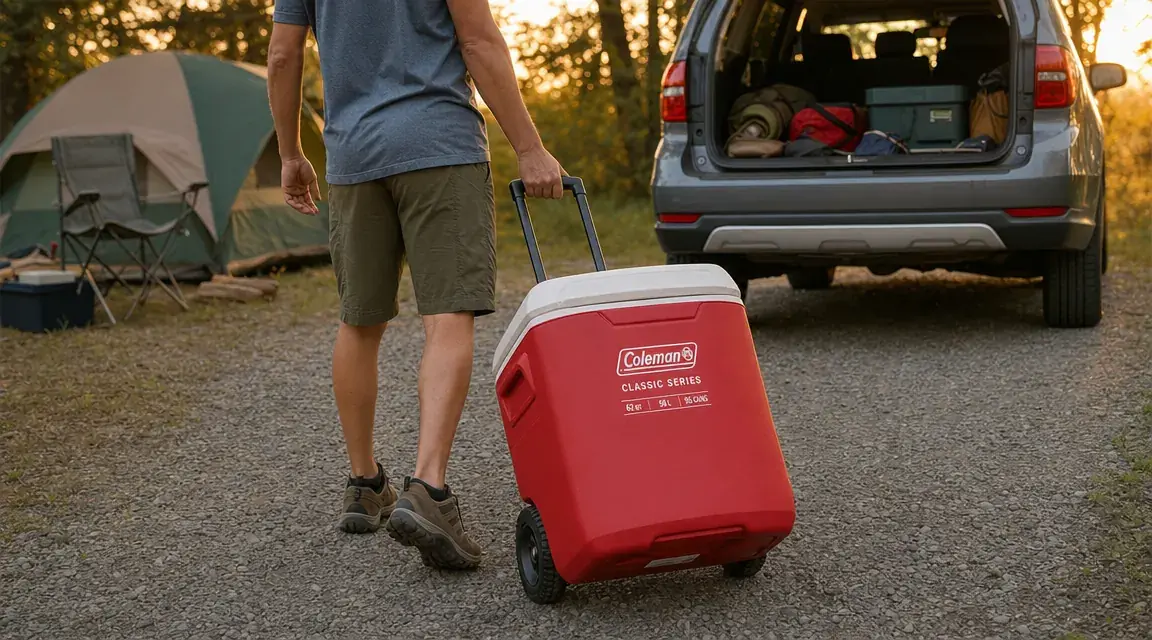
The wheels are the headline feature for me. They are not tiny plastic furniture casters. They are actual 6-inch diameter wheels with real rolling resistance on gravel. I rolled this cooler loaded to about 55 pounds across a gravel campground loop and across a root-crossed forest path without it tipping or the wheels locking. The axle is thick plastic rather than stainless steel, which I will come back to under cons, but day-to-day the rolling experience is substantially better than the soft-wheeled coolers I have tried.
The telescoping handle extends to 35 inches, which is the right height for someone who is 5 feet 6 inches tall without requiring a stoop or an awkward arm angle. At 5 feet 4 inches myself, it is comfortable to pull on flat ground. The locking mechanism on the handle is simple and reliable. I have not had it collapse mid-pull.
Capacity at 62 quarts is genuinely 62 quarts. That translates to about 90 cans, or in practical terms, two adults' full food for four nights plus a moderate amount of drinks and a full ice load. I was not playing Tetris to fit everything in. There is a measurable difference between this and a 48-quart cooler, and it matters once you factor in the space ice takes.
The leak-resistant lid seal is worth noting. At the end of trip two, I had several quarts of meltwater in the cooler. I carried the cooler on its side briefly to load it into the truck, and nothing leaked through the lid seam. The seal is not airtight or pressurized like a premium rotomolded cooler, but it does what it claims.
Where It Falls Short
The lid is the weak point I noticed first. It is thinner than the walls and flexes when you press on it. I have seen some reviewers use the lid as a seat, and I would not. It will survive normal camping use but it is not built for abuse, and the thinner foam in the lid is part of why ice retention degrades faster when the sun hits the top of the cooler directly.
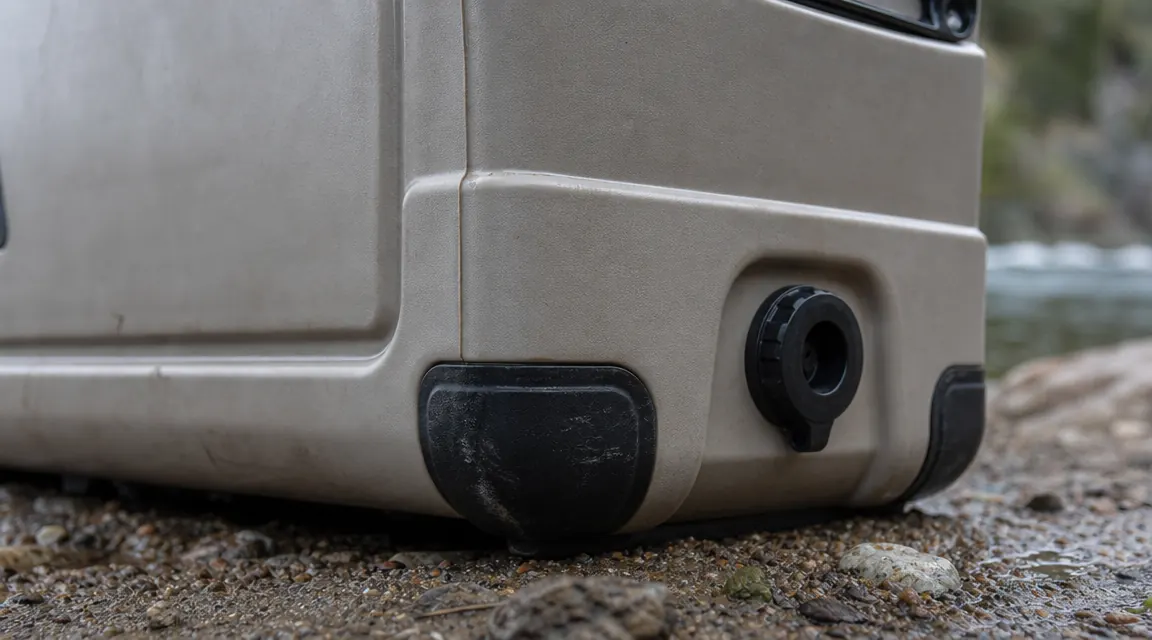
The drain plug is functional but rattles when the cooler is empty and rolling across rough ground. It is a molded plastic plug with a tether, and it has worked reliably for drainage, but it is not the satisfying threaded metal plug you get on a Pelican or an Orca. This is a minor complaint but worth mentioning because the rattle on a quiet morning is genuinely annoying.
The wheel axle is plastic, not metal. It has held up fine over eight months and three trips, but I would not want to regularly pull this cooler over sharp rocks or drop it loaded from the back of a pickup repeatedly. The axle is probably the component most likely to fail on heavy, repeated use.
At loaded weight, this cooler is 55 to 60 pounds. The wheels handle it fine on flat ground, but getting it in and out of an SUV or truck bed requires two people or a specific technique involving the tailgate as a ramp. Do not expect to single-hand this from the truck bed. It is a two-person lift when loaded.
What I Liked
- Real 4 to 4.5-day ice retention in cool conditions (58-65F nights)
- 6-inch wheels roll smoothly on gravel, packed dirt, and moderate trails
- Telescoping handle extends to 35 inches with a reliable locking mechanism
- 62-qt capacity holds a full four-night food load for two adults with ice
- Leak-resistant lid seal holds up when the cooler is tilted or jostled
- Flat base is stable on uneven ground and does not rock
Where It Falls Short
- Lid is thinner than the walls and flexes under pressure; do not sit on it
- Drain plug rattles when empty; minor but noticeable on quiet mornings
- Plastic wheel axle is the most likely failure point under hard repeated use
- Needs two people to load or unload from a truck bed when fully packed
- Ice retention drops to about 3 days when overnight temperatures stay near 70F
By the morning of day four, I still had visible chunks of block ice. For a cooler at this price, that is a result that held up to the marketing claim.
How It Compares to What I Used Before
My previous cooler was a 48-quart lidded box style from a big-box store. No wheels, no telescoping handle, about the same wall thickness as the Coleman Classic. The difference between the two is not primarily insulation performance. It is the wheels and the capacity. Rolling a 60-pound cooler from a parking area to a campsite a quarter mile away is an entirely different experience than carrying a 45-pound cooler by two thin handles across gravel. My forearms and shoulders noticed immediately.
I have not tested the Coleman Classic against an Igloo MaxCold side-by-side, but based on published specs the wall construction is similar. If you want that detailed comparison, I worked through it in my Coleman vs Igloo MaxCold article. The short answer is that both coolers perform comparably in controlled conditions, and the Coleman's wheel system is more robust.
Packing Tips That Actually Extended Ice Life
Pre-chilling the cooler the night before made a measurable difference. On trip one I pre-chilled. On trip two I did not, due to a departure-morning scramble. The trip two results were worse, but I cannot fully separate that from the warmer overnight temperatures. My recommendation based on three trips: pre-chill if you have the time, and always lead with a bottom ice layer before any food goes in.
Block ice lasts significantly longer than cubed ice in a cooler like this. I used one 10-pound block per trip buried in the center of the food load. The block was still partially intact on day three in all three tests, where the cubed ice in the corners had turned to cold water by the end of day two. If your grocery store does not carry block ice, freeze water in large zip-lock bags the night before departure.
Keeping the cooler in the shade is obvious advice but it is worth quantifying. On the one afternoon during trip three when I left the cooler in direct afternoon sun for about three hours, I lost roughly six hours of ice life compared to my baseline from the other trips. The lid, being the thinnest part, is the most solar-heat-vulnerable face of this cooler.
Who This Cooler Is For
The Coleman Classic 62-Qt Rolling Cooler is the right cooler for car campers doing trips of three to five nights who want reliable ice retention without spending $300 or more on a rotomolded premium cooler. It is especially well-suited to sites that involve any walk from a parking area to the campsite, since the wheels handle gravel paths that would make carrying a standard cooler miserable. It is a good fit for couples and families where a 48-quart cooler has felt tight on food space. If you camp mostly at sites where you can park directly at your site and the walk is zero, the wheel system is less meaningful, but the 62-quart capacity and insulation performance still hold up as reasons to buy.
Who Should Skip It
If you camp in the deep south in summer, or anywhere nights consistently stay above 70 degrees, you will get three days of ice retention at best and probably less. A rotomolded cooler with two or more inches of foam and a pressurized seal holds ice meaningfully longer in hot conditions, and that gap matters more than the price gap when your food safety depends on it. This cooler is also not a fit for backpacking or any trip where you carry gear more than a quarter mile over rough terrain. The wheels stop being useful the moment the trail gets technical. At 18 pounds empty it is too heavy to carry on your back for any real distance.
Three trips in, I would buy this cooler again at current pricing.
The Coleman Classic 62-Qt is under $75 on Amazon right now. For a car camping cooler that rolls, holds a real food load, and delivers four-plus days of ice in cool conditions, that is a reasonable ask.
Amazon Check Today's Price on Amazon →